
In legal practice, small details are not mere margins; they are the keys to solutions that can completely shift the balance of a case.
Background
One of our clients (a tenant of a commercial shop) had been compelled to sign a lease termination agreement under which he undertook to vacate the leased premises on a specified date. However, due to the severe losses that vacating on that date would have caused, and due to unforeseen circumstances that arose thereafter, it became impossible for him to comply with the agreement and vacate the premises on the agreed date.
Accordingly, he approached our office seeking assistance to extricate himself from this predicament and to find a legal solution that would allow him to remain in the leased premises for a period beyond that stipulated in the agreement.
Our Approach
Following an in-depth review of the case file, we identified a critical and decisive detail:
In an attempt to increase pressure and ensure eviction, the landlord issued a formal legal notice
(notarised warning) demanding eviction on the grounds of “personal use.” Notably, the date of this legal notice was subsequent to the date of the lease termination agreement.
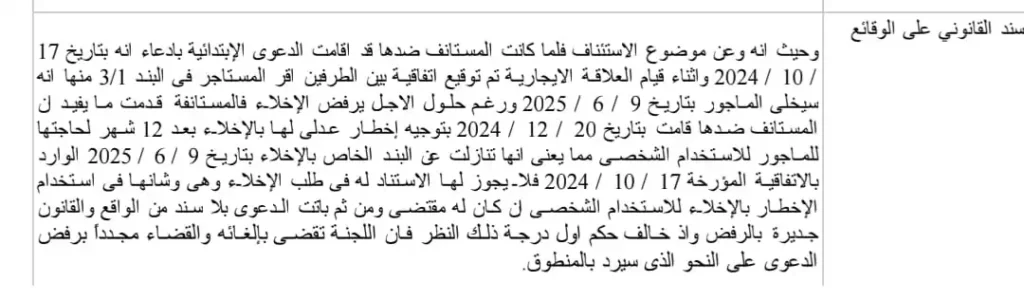
This was the turning point. Before the court, we argued that the issuance of this legal notice constituted an implicit and legal waiver by the landlord of the prior termination agreement, thereby restoring the lease relationship to its original status and nullifying the legal effect of the termination agreement.
Outcome
Although the Court of First Instance initially ruled in favour of eviction based on the termination
agreement, we did not relent. Our firm belief in the soundness of the legal argument led us to file an appeal. Ultimately, the Court of Appeal overturned the first-instance judgment and upheld our
argument that a valid waiver had occurred, enabling the tenant to remain in the leased premises and rendering the eviction agreement ineffective.
Key Takeaways
- A later formal notice can impliedly waive an earlier lease termination agreement.
- Procedural details — dates, notices and their sequence — can decide a tenancy dispute outright.
- A signed termination agreement is not always the end of the analysis; subsequent conduct matters.
Case studies are published in summary form. Details have been generalised and identifying information omitted to preserve client confidentiality. Past results do not guarantee a similar outcome in any future matter. This publication does not provide any legal advice and is for information purposes only.