
Precision Litigation in the Dubai International Financial Centre (DIFC)
Trusted, high-stakes representation for multinational businesses, senior executives and investors, combining global-firm standards with the precision of a specialist UAE practice.
DIFC Courts Legal Services in UAE
The DIFC Courts operate as an independent English-language common law judiciary, distinct from the civil law system of mainland Dubai. They apply their own substantive laws, modeled on the principles of English law, and follow rules of evidence and procedure comparable to the Commercial Court in London.
For international businesses, this offers certainty. We navigate the nuances of the DIFC Court Rules (RDC) to secure injunctions, freeze assets, and enforce contractual rights with a speed and predictability that aligns with global commercial standards.
GET IN TOUCH
Book your appointment with our DIFC specialists
SK Legal’s DIFC Courts Expertise
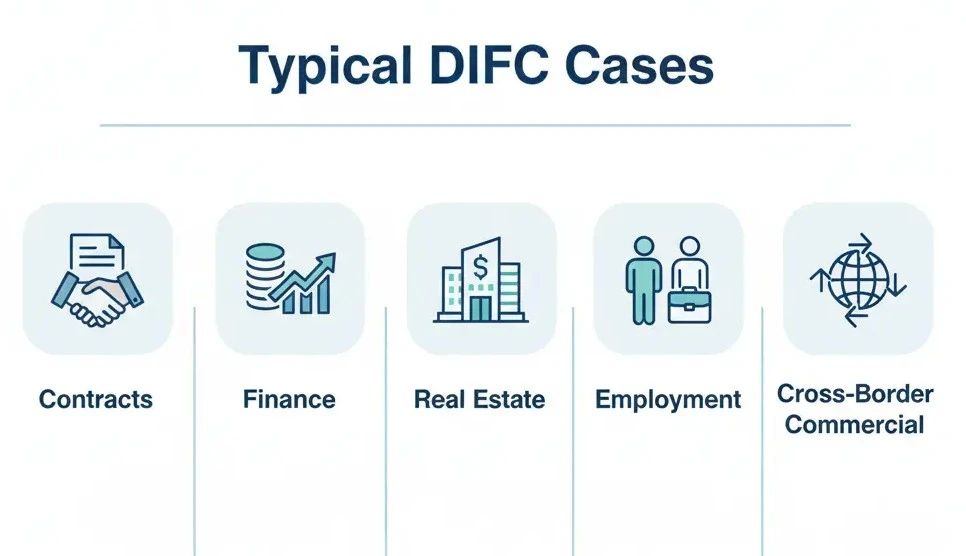
We advise and represent clients across a wide range of DIFC Court matters, including:
Contractual and Commercial Disputes in the DIFC Courts
What the dispute involves
We handle complex breach of contract claims, shareholder deadlock, and unfair prejudice petitions. Unlike generalist firms, we focus on the specific statutory interpretations of the DIFC Contract Law (No. 6 of 2004) and the Law of Obligations (No. 5 of 2005).
How SK Legal Assists
- Specific Performance & Injunctions: Rapid deployment of equitable remedies to stop breaches before they cause irreparable harm.
- Damages Quantification: Sophisticated modeling of expectation losses and reliance damages under DIFC precedents.
- Jurisdictional Strategy: Drafting robust “Opt-in” clauses to secure DIFC jurisdiction for international parties under the Judicial Authority Law.
Employment & Executive Advisory
What the dispute involves
DIFC employment is governed exclusively by DIFC Law No. 2 of 2019 (as amended), distinct from UAE Federal Labour Law. We specialize in high-value disputes involving C-suite executives, bankers, and regulated individuals.
How SK Legal Assists
- Executive Termination: Litigating “cause” vs. “without cause” dismissals and the Article 59A discrimination provisions.
- DEWS & End of Service: Advising on the DIFC Employee Workplace Savings (DEWS) scheme and recovery of unpaid Qualifying Scheme contributions.
- Restrictive Covenants: Enforcing or defending against non-compete and non-solicitation clauses in the DIFC Courts.
Insolvency, Restructuring & Asset Recovery
What the dispute involves
Moving beyond simple debt collection, we use the sophisticated DIFC Insolvency Law (No. 1 of 2019). This regime allows for “Debtor-in-Possession” rehabilitation, similar to US Chapter 11 or UK Administration, offering a lifeline to distressed companies.
How SK Legal Assists
- Rehabilitation Plans: Guiding distressed entities through court-supervised restructuring moratoriums.
- Winding Up Petitions: Acting for creditors to compel liquidation of insolvent debtors.
- Worldwide Freezing Orders (WFO): Securing assets globally using the DIFC Courts’ extraterritorial reach to prevent dissipation during litigation.
Real Property & Leasing Litigation
What the dispute involves
We represent commercial landlords, developers and corporate tenants in disputes governed by the DIFC Real Property Law (No. 10 of 2018) and the DIFC Leasing Law (No. 1 of 2020).
How SK Legal Assists
- Commercial Eviction: navigating the strict notice requirements for lease termination and forfeiture.
- Strata Disputes: Representing Body Corporates or owners in service charge and common area management disputes under the Strata Title Law.
- Development Liability: Litigating decennial liability and defect claims against developers.
Construction & Technology (TCD)
What the dispute involves
Technically complex disputes are heard in the Technology and Construction Division (TCD) of the DIFC Courts. These cases require a mastery of both standard form contracts (FIDIC) and the specific evidentiary rules of the TCD.
How SK Legal Assists
- TCD Advocacy: Specialist representation for engineering failures, delay analysis and variations.
- Digital Economy: Handling disputes related to blockchain and digital assets in the DIFC Digital Economy Court (DEC).
- Performance Bonds: contesting or defending the calling of on-demand bonds.
WHY BUSINESSES CHOOSE SK LEGAL
GET IN TOUCH
Book your appointment with our DIFC specialists
FAQs: Answering Your DIFC Court Concerns
GET IN TOUCH
Get Expert Legal Advice on DIFC Courts with SK Legal
Looking For Legal Advice in UAE?
Opening Hours
Monday-Friday
09:00 AM – 05:00 PM
Satuarday-Sunday
Closed
Office Address
Registered Address
SK Legal Consultants FZ LLC B4-212A6,
Business Centre 04
RAKEZ Business Zone-FZ Ras Al Khaimah